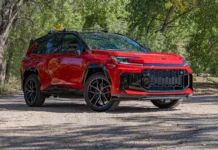
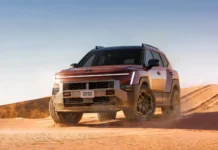
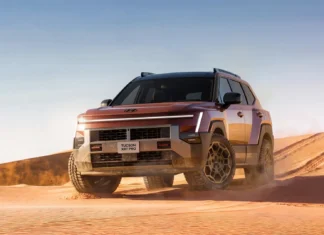
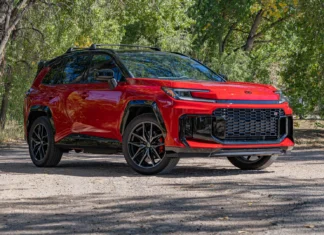
Hyundai is on an angular kick with its redesigned SUVs, and the 2027 Tucson is the latest to get the treatment.
Alongside the existing Santa Fe and recently renovated Palisade, here comes Hyundai with the third act: the new Tucson. The automaker just debuted the look of its fifth-generation compact SUV Wednesday, and it is absolutely nothing like the model that precedes it (or any of the other Tucsons, for that matter).

Much in the same spirit as its larger siblings as well as models like the Nexo and even the Boulder concept, Hyundai is going bold and fairly boxy for all its SUV designs. The 2027 Tucson brings dramatic angles to the front, the profile and the rear, giving this generation some more serious presence against the outgoing generation. There’s also a totally different lighting signature, with headlights embedded into the lower fascia so you almost don’t see them at all. Then, along the flared fenders and across the upper fascia, you get thin lights that will definitely make the Tucson look distinctive at night.
At the back, the same lighting theme defines the Tucson’s signature, though you can more clearly make out the ‘H’ pattery Hyundai is going for with its new design. To the rounded flanks of the old model, this one looks much chunkier and substantial, even though we don’t have full technical specs on how much the dimensions have changed just yet.
Inside, the new Tucson gets a similar vibe to its larger siblings. The light-and-dark contrasting materials make the new Tuscon at least look a little more spacious, while a large center infotainment screen dominates the dashboard area. Instead of having two similarly sized screens side-by-side, though, Hyundai is going with a slimmer digital gauge cluster positioned closer to the A-pillar, in the driver’s line of sight.
Like it or not, the 2027 Hyundai Tucson also gets a squircle-shaped steering wheel that’s smaller, with a flat top and bottom. We’re not huge fans, generally speaking, but it’s not super crazy compared to the yoke setups some automakers rolled out over the years. It also looks like you still get a host of buttons to control functions on both the cluster and center screens. Apart from a few hard controls below that large infotainment display, however, it appears Hyundai is couching many of the top-level controls into the touchscreen. Here’s hoping it actually works well (though voice commands and connected features like an AI assistant will almost certainly factor into the mix.

What about powertrains, price and availability?
Hyundai’s Wednesday announcement did confirm the Tucson XRT would continue, so we can expect a more rugged version to be part of the revamped fifth-generation lineup. Beyond that, it’s likely Hyundai will continue to offer a mix of powertrain options, from gas-only options to hybrids.
For now, we just have a design preview of how the 2027 Hyundai Tucson will look. More technical details will follow, though we may not know more for another couple months. Eventually, with today’s announcement as a bit of foreshadowing, we expect to see more on the new Tucson by the fall. That puts a potential launch window in the first half of 2027 in the cards, though we’ll have to await actual conformation from Hyundai on that.
As for pricing…again, it’s anyone’s guess, really. The current Hyundai Tucson runs anywhere from $31,350 all the way up to nearly $50,000 with gas, hybrid and plug-in hybrid models in the stack. The general trend with next-generation models is to shift that pricing band upward. Perhaps that would put a “base” Tucson (something like an SE) somewhere near the mid-$30,000s, though Hyundai will define the MSRP at the top end by what powertrains and trims are going to carry on into the redesigned SUV. We’ll have to wait and see.
The TFL team has been pretty stoked about Hyundai’s current design trend, and I’ll throw my hat in the ring again with the new Tucson. It looks like Hyundai has another winner on its hands, though please do let us know what you think below.