
| Pros | Cons |
| ✓ Much, much better than the old bZ4X | ☓ All-terrain tires make it hard to use that power |
| ✓ Comfortable ride | ☓ Insufferable driver attention monitor |
| ✓ Tons of interior space | ☓ Functional (if not the most exciting) interior |
| ✓ 375 horsepower ain’t bad |
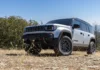
Overview: The latest Toyota bZ Woodland takes the original formula and improves it in (almost) every way.
When the Toyota bZ4X (later just ‘bZ’) and its Subaru Solterra sibling rolled out a few years ago, we in the TFL office more or less had the same reaction…and it wasn’t a positive one. You questioned how much the automaker really tried — particularly with the looks, the range and the charging speed. Well, fast forward to this latest update, as Toyota further expands its EV lineup with not just the wagon-like bZ Woodland as a step up from the smaller bZ, but also the small-but-powerful C-HR, and it’s a different story. After taking this bigger, more adventure-minded Woodland out for a bit of leaf-peeping before winter soon (hopefully) hits the Rockies, I came away with a simple, succinct takeaway: I like it.
What exactly makes the bZ Woodland different from the “normal” bZ?
While they both ride on the same platform, the latter is more of your straightforward compact SUV, the more rugged-looking Woodland gets some powertrain and visual cues to set it apart. For a start, the bZ Woodland is 190.2 inches long, so it’s about 5.6 inches longer, which aids cargo room (up to 71.8 cu. ft. with the JBL audio system).

Beyond that, the Woodland is also exclusively available with a dual-motor all-wheel drive system with a hearty 375 horsepower on tap, to the bZ’s maximum possible 338. You also just get the larger 74.7-kWh battery (with ~67-kWh usable), which brings the potential range to 281 miles…or 260 if you get the all-terrain tires (more on that later). The bZ Woodland gets a slight improvement in ground clearance over the bZ at 8.4 inches, and you also get Subaru’s X-Mode traction control system for low-speed traction on dirt, rock or snowy surfaces. Finally, Toyota wraps up the bZ Woodland’s package with the necessary badging, matte black fenders and wheel arch cladding, and a 2-inch receiver hitch to enable 3,500 pounds of towing, whereas the normal bZ isn’t rated to tow at all.
More stuff = more money, right?
With a larger stature, more capability and a special range of features, you’d likely expect the bZ Woodland to be more expensive than the bZ to start. You’d be right, because the 2026 model starts at $46,895 for the base (non-Premium) Woodland. Since you have to get it with the big battery and AWD, that makes the starting price about $10,400 more than the standard bZ’s starting price. That said, once you spec an AWD version of the smaller bZ, you cut that price delta in half.
Step up to the bZ Woodland Premium, which we have here, and the starting price rises to $48,995. The extra cash you pay adds in a 9-speaker JBL audio system, heated and ventilated front seats, memory settings for the driver’s seat a digital rearview mirror, heated power-folding side mirrors and a panoramic fixed glass roof with a sunshade.
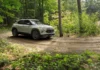
This 4,519-pound bZ Woodland is more capable than it should be, both on- and off-road.
Whether or not you’re fully down with the EV crowd, one cool feature most folks will like is the punchy acceleration. Not only does the 375 horses the electric motors kick out capable of launching the bZ Woodland to 60 mph in about 4 seconds, but it can do that anywhere. Even up at nearly 10,000 feet on the Peak to Peak Highway, which I was all too happy to hit in search of the season’s changing colors. The bZ Woodland can blast between the corners and that’s a lot of fun, even if the Dunlop Grandtrek A/T tires spoil the on-road handling a bit.
See, the 2026 Toyota bZ Woodland, much like virtually any other car out there, has to compromise somewhere. Even with a healthy amount of power just a press away, it’s pretty easy to overwhelm those tires if you try to treat it like a sports car. The A/T tires tilt the balance even further away from exceptional grip on the pavement, though I will note they do help insulate the remarkably comfortable ride even further.
Once you get off the pavement a bit, things look up. Granted, you don’t want to take your 4,500-ish pound EV with 8.4 inches of ground clearance on the Rubicon, as you’ll more than likely beach the car on tougher obstacles. That said, both through the TFL Slip Test and my own mini-excursion off Peak to Peak, the Toyota bZ Woodland is not bad at all, particularly when you make use of X-Mode’s various Grip Control settings. If you do find yourself in some loose sand, the composite underbody panels and battery structure does keep everything relatively safe, though to be clear that is for light off-roading or gravel/snow.
What about that range and charging capability?
I mentioned earlier that selecting the 18-inch wheels and Grandtrek tires will curb your range a bit. With the A/T option, Toyota says you can expect around 260 miles on a charge. That’s decent by today’s standards, though it’s worth noting that’s a massive improvement over the old bZ. In mixed driving both up and back down from the mountains, that figure seems to be about bang-on, though the real difference here is with the charging setup.
This time around, the Toyota bZ Woodland uses a NACS-style charging port, with the thrown-in dual-voltage charging cable pretty much cribbing Tesla’s design where you actually plug it into the car. The provided cable allows 120- or 240-volt charging, with the latter able to charge the battery in about 7 hours. If you head to a DC fast-charger, you can expect a maximum input of 150 kW — a 50% improvement over the old bZ — and a 10-80% recharging time of about 30 minutes. Much like the range, it’s not earth-shattering, but it’s much better and still usable in everyday living. If you head to a non-NACS/Tesla DC charger, Toyota also provides a CCS adapter so you can still charge up on a trip.
The bZ Woodland’s interior is more or less identical to the standard bZ, and that’s fine…mostly.
Right from the jump, the latest Toyota bZ Woodland comes well-equipped for the money. Apart from the differences I mentioned with the premium, every model gets a 14-inch touchscreen, digital gauge cluster, dual wireless charging pads and heated front/rear seats. Most everything is easily at-hand and intuitive to use, though you do have to use the touchscreen to adjust the HVAC fan speed as well as the steering wheel and seat climate controls.
That is a little annoying, but it’s nowhere near as annoying as Toyota’s nagging safety systems. Look, to an extent I get it: Toyota’s Safety Sense 3.0 is meant to make the car as safe as can be, including monitoring the driver for possible distractions or worse. But look anywhere other than directly ahead for more than half a second (like checking your mirrors), and the system bongs at you with a cluster warning that you’re not paying attention. Put your hand at the 12-o’clock position on the steering wheel, and the attention monitor freaks out because the camera can no longer see you.
Then there’s Toyota’s boilerplate seatbelt warning, which literally screams at you if you take too long to put your seatbelt on or start rolling without doing so. Again, I know part of that is down to regulation, but…holy crap is it irritating. I still give Volvo the gold medal for being the sort of nanniest car on the market, but Toyota’s up there.
Fortunately, there’s little else to gripe about with the bZ Woodland’s interior.
As far as the rest of the cabin goes, however, the 2026 Toyota bZ Woodland hits the mark. You get an extra 1.3 inches of headroom over the standard bZ thanks to the more wagon-like profile, in addition to the cavernous amount of space in the cargo area. Out back, you also get some underfloor storage and a 1500-watt, 120-volt AC outlet. Along with the wireless charging pads for the front passengers, the rear passengers get two 60-watt USB-C ports, so everybody can charge up to their heart’s content.
While you do get some decent storage in the door pockets, a side-hinged center console lid and more space beneath the floating console, the only “miss”, if you can call it that, is the bZ’s lack of a glovebox. The Stone Brown-on-gray interior palette is also a bit muted, even boring, but it is technically better than the full-black SofTex interior option.
In terms of connectivity, the Toyota bZ Woodland more or less gives you everything you’d want. The company’s latest infotainment system is snappier and more responsive than Toyotas of yesteryear, while you also get wireless Apple CarPlay and Android Auto support. You further get control for the 64-color front and rear ambient lighting (that helps jazz up the interior at least a little bit), and Toyota’s 360-degree Panoramic View Monitor system comes as standard equipment on both Woodland trims.
Verdict: Is the new Toyota bZ Woodland actually worth it?
Bringing everything full-circle, I’ll reiterate I was absolutely not a fan of the original bZ. The thing is, as the EV space evolves, more competitors join and the cars get better and better, Toyota’s initial effort just felt half-baked. This generation bZ and bZ Woodland feel like cars that spent some time in the oven, where you actually have not one, but two appealing options depending on your lifestyle and budget.
At $50,888, our particular 2026 Toyota bZ Woodland Premium added on roof-top crossbars ($350), rear hatch cargo lights ($275) and the “Adventure” Tow Package ($1,268). As far as getting the most rounded electric wagon to get out there and do stuff, this bZ Woodland is the top of the heap for what the lineup offers. Broadly speaking, it offers up a similar package and price band to the Chevy Blazer EV and now-defunct Honda Prologue, and comes in around the same price as a Hyundai Ioniq 5 XRT, though this is more spacious. The Ford Mustang Mach-E Rally offers up a serious performance package, but also comes in at least $8,000 more expensive in the process.
Against that bunch, the Toyota bZ Woodland offers up a well-balanced option for the money, so I would recommend at least trying one out. It does come in at a far lower price (at least for now) than the Rivian R2, as well, and you get the warm comfort of that Toyota badge, for whatever that’s worth to you. On that note, Toyota offers an industry-standard 8-year/100,000-mile battery warranty, on top of the standard 3-year/36,000-mile bumper-to-bumper coverage and 5-year/60,000-mile powertrain assurance. ToyotaCare covers the first year or 10,000 miles of maintenance, too.
If you’re shopping for a capable, spacious, comfortable and surprisingly capable EV, then I’d say the Toyota bZ Woodland should be on your list. If you’re looking for a 2027 model by now, the pricing hasn’t changed too much from 2026, with MSRPs going up by about $80 to start.
Depending on where you land with the bZ’s styling, another alternative is the mechanically identical Subaru Trailseeker. Both ride on the same platform, but the Subaru brings some subtle changes (and a different price tag) to the equation. We’ll have more comprehensive reviews on the Trailseeker coming up soon.