The redesigned 2027 Hyundai Tucson gets a bigger and bolder look — check it out!
Hyundai has been making some dramatic moves with its recent launches, and the new Tucson is no exception. This generation — the fifth in 22 years — is arguably the most dramatic yet. The automaker revealed its latest Tucson in New York City Thursday, rounding out a major redesign of each of its three best-selling models (the others being Santa Fe and Palisade) over the past three years.
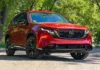
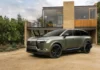
The 2027 Hyundai Tucson brings a larger and more assertive look to the equation, as well as a next-generation hybrid system and more technology. Right off the bat, the company’s Art of Steel design philosophy takes center stage, which homes in on more pronounced and muscular proportions balanced out by sharp and clean body lines. Hyundai says that language is meant to “showcase the inherent tension and strength of steel”, though to the lay person it means that this generation Tucson is much more distinctive than we’ve seen in past generations, including the outgoing model’s more rounded stature.
Overall, the new Tucson rides on the same platform as the old car, but is 2.4 inches longer, 1.6 inches wider and 0.8 inches taller than the previous SUV.


A next-generation hybrid system brings more power and up to 42 MPG.
While a bold new look headlines the 2027 Hyundai Tucson lineup, the automaker is broadly sticking to its ICE/Hybrid/Plug-in Hybrid arrangement for this new generation. At the gas-only end, either a 2.0-liter naturally-aspirated four-cylinder or 1.6-liter turbocharged four-pot will be available, depending on the market, with the latter making 187 horsepower and 195 lb-ft of torque on its own.
As far as the other two versions are concerned, the 1.6-liter turbo is still part of the equation, just with electric motors backing it up. The conventional Tucson Hybrid model gets a slight power bump to 242 horsepower and 280 lb-ft of torque (up from 231 hp/271 lb-ft before). Depending on the model, Hyundai also quotes better fuel economy of up to 42 MPG if you get front-wheel drive, and 40 mpg with all-wheel drive.
If you’re looking for more all-around capability, the 2027 Hyundai Tucson Hybrid also gets 3,000 pounds worth of towing capacity, which is half a ton more than the old car, provided you have a trailer equipped with brakes to handle the extra weight.
The Tucson Plug-in Hybrid is beefier still, with 284 combined horsepower and 258 lb-ft of torque. That makes it the quickest to 60 (though 7.9 seconds is still a bit pedestrian by modern standards), though efficiency is more the name of the game. A 17.1-kWh battery is here instead of the 1.49-kWh battery in the hybrid, promising up to 50 miles of all-electric driving. With the new Tucson PHEV, you get a 7.2-kW onboard AC charger, but no DC fast-charging capability.

The Tucson XRT Pro offers up a more serious off-road package than before.
Much like the Palisade XRT Pro, the 2027 Hyundai Tucson lineup is further expanding with a more off-roady version of its own. Sitting above the standard Tucson XRT, which is more of a styling package, the XRT Pro actually gets a 1.2-inch suspension lift and an expanded cladding package, for a start.
With the XRT Pro, you also get proper recovery hooks, all-terrain tires and more technology to help you when you actually go off-road. On the technology front, Hyundai is bringing new features like Target Speed Control, an off-road cruise control between about 1.3 and 15 mph, and Smart Terrain Assist, that uses AI in coordination with the onboard camera system to assist the terrain and recommend the safest driving line and automatically switch drive modes to suit the conditions.


Looking inside the 2027 Hyundai Tucson
When it first debuted in South Korea, I mentioned the 2027 Hyundai Tucson broadly packs a similar vibe to its larger siblings. That still holds here, as you get a more upright dashboard and a redesigned steering wheel with four dots on the horn pad (to simulate the letter ‘H’ in Morse code). The new Tucson also ditches the old console-mounted shifter for a shift-by-wire setup on the steering column, to make more space for dual 15-watt wireless charging pads.
Based on Android Automotive OS, that new infotainment setup runs Hyundai’s latest Pleos Connect software. This bakes in the ‘Gleo AI’ assistant, and is designed to handle more complex commands in a conversational matter, including tasks with multiple steps. So, for example, you can tell it to turn off the A/C, open the windows and crank up the stereo.
Tucson Hybrid models also get another party trick from the EV lifestyle, with Stay Mode. This mode allows the HVAC, audio and device charging to run off the high-voltage battery, rather than automatically shut the car off after a certain amount of time like an accessory mode would (to prevent draining your standard 12-volt battery).
One key difference with the new Tucson is the gauge cluster and infotainment screen layout. The standard display in front of the driver has been replaced by a thinner, 9.9-inch display sitting higher up the driver’s line of sight. Next to that, a huge 17-inch touchscreen dominates the rest of the dashboard (though lesser models will get a 12.9-inch unit instead). Another option to manage heat inside the new Tucson is metal-coated heated glass, which packs the ability to de-ice the windshield in about 15 minutes, and keep the interior a couple degrees cooler in the summer through rejecting more of the sun’s radiant heat.
When will the 2027 Hyundai Tucson be available?
Hyundai says the new Tuscon will launch in South Korea later this year, with Europe, North America and other global markets to follow in calendar year 2027. One thing we don’t know about it (and usually don’t at this stage) is pricing.
The current Tucson starts right around $31,000 for the ICE model and runs all the way up to $51,000 for the highest-spec Plug-in Hybrid. With a major generational update like this, I would count on the 2027 models getting at least marginally more expensive. As for the Tucson Hybrid — where the automaker seems to be most intensely focusing this launch — we’ll likely see prices in the mid-$30K to mid-$40K range.