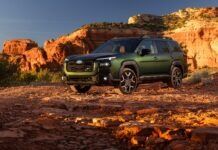
The 2026 Jeep Recon adds a powerful and more off-road-capable electric option to the lineup.
For so many folks out there, you only really have one answer as to what is truly a “real Jeep”: the Wrangler. Old-school construction, serious off-road capability and the option to take both the doors and the roof off are the things that matter, and those are something the brand’s other models — particularly the luxury-focused, electric Wagoneer S — haven’t captured. Until now, that is, because we’re looking at the next electric model in the brand’s stable, with the 2026 Jeep Recon.
In some aspects, we’re looking at “second verse, same as the first”, at least on paper. We’re still looking at a dual motor SUV with a decent-sized 100.5-kWh (gross capacity) battery onboard. Put your foot down, though, and you have a whopping 670 horsepower and 620 lb-ft of torque at your disposal. Jeep invited us out to California to test out the Recon’s sheer power and acceleration (it claims 0-60 in 3.6 seconds) both on-road and — far more importantly for this open-top Wrangler alternative — its off-road chops.


Taking a closer look at the 2026 Jeep Recon
While the Jeep Wagoneer S leaned toward a more luxurious and svelte SUV, the Recon brings everything closer to the brand’s off-road roots. You see a stronger resemblance off the bat, by way of an upright, illuminated seven-slotted grille and a blockier overall design. That carries throughout the whole exterior, including the square, Cherokee-esque headlights through the full-on box profile to the taillights. It’s big, it’s chunky and it at least has the look of a rig that isn’t messing around.
All that said, it fundamentally shares a platform with its EV sibling, and that cuts both ways in the capability department, as we’ll get into in the video below. It measures out about 6 inches longer than a four-door Wrangler, and this Moab trim has significantly less ground clearance than a Wrangler Rubicon. At 9.1 inches, it measures out a bit closer (though still lower overall) to the Sport or Sahara models, even though this off-road-minded Recon Moab does pack 33-inch Nexen Roadian ATX tires.
The two 335-horsepower electric motors definitely offer plenty of shove, while the instantaneous torque can be useful to meter out the power, whether you’re on pavement or not. It also offers up 33.8 degrees of approach and 33.1 degrees of departure, as well as 23.3 degrees of breakover when you do want to take on some trickier obstacles. All things considered, that’s really not bad, and the Recon also gets Mud/Sand and Rock modes on the familiar Selec-Terrain switch, as well as a selectable rear locker within the drive unit (though you don’t get a front one).
The 2026 Jeep Recon Moab further gets red-painted recovery hooks, plenty of underbody armor, and the battery is sealed up nice and tight so you can ford through water up to 24 inches deep. The 15:1 final drive ratio in addition to that rear locker so the rear end, at least, can deliver plenty of torque down to the ground, though you don’t get further gearing reduction through a two-speed transfer case, like you would on a gas-powered Wrangler or most other purpose-built 4x4s.
What is disappointing, on the other hand…is the EV baggage the Recon brings into the equation.
You’re meant to take this vehicle well off the beaten track to places like Moab — it’s in the name, after all — and how far can you go? Go for this all-terrain trim with 33-inch tires, and you’re looking at…222 miles. That number may be pleasantly symmetrical, but there’s no way to sugarcoat this: It’s not enough. You can’t fix a dead battery with a jerry can, and even when you can charge up, you’re topping out at about 200 kW on a DC fast-charger thanks to this car’s 400-volt architecture.
After a day’s driving, both Tommy and I can confirm range anxiety is still alive and well in this Jeep Recon. Over 116.6 miles, we used 57% of the available charge, or about 2.5 miles per kilowatt-hour. That’s not Hummer EV levels of inefficiency, but we are talking about a 6,100-or-so-pound brick of an EV, and you’ll feel it if you try any long-distance excursions.
The Jeep Recon is still quick as hell, though, and (mostly) nicer to drive than its gas sibling.
But what about the rest of the experience? Broadly speaking, the 2026 Jeep Recon’s interior execution and on-road dynamics are also a case of win-some, lose-some. The Joshua Tree tan upholstery, much like the rest of the interior, uses a wide range of recycled material, but still look and feel decent. You get a digital gauge cluster and 14.5-inch infotainment screen rocking the latest Uconnect operating system, that also gives you access to EV-specific readouts and controls like Creep (that lets the car roll forward like a conventional automatic car when you let you foot off the brake), as well as off-road pages.
The coolest part of the new Jeep Recon, though, comes down to all the removable panels. Now, I would not recommend taking the doors off by yourself. You can do it if you’re strong and careful enough, but at 70 pounds for the front doors and 60 for the rears…it’s best done with two sets of hands. That said, you just unplug one wiring harness, swing each of the doors a bit past 90 degrees and pull straight up, so it’s a pretty easy job to execute, and you don’t need any tools to do it. On the down side, there isn’t anywhere to actually store the doors once you take them off, so this is more of a decision to make before you head out.
It’s a different story for the windows, though. Both the rearmost side windows and the rear tailgate window are removable, again in just a couple steps. You don’t get a fully removable top with the Recon, but you do get Jeep’s Sky One-Touch roof that neatly rolls the movable section of the roof back on-demand. So, it’s essentially halfway between something like a 4Runner and a Wrangler/Bronco, but you’re about as close to the Wrangler experience here as you can get without just buying a Wrangler. For what it’s worth, the center console and glove box are also lockable for some secure storage when you do take the doors off.
Okay, but how much does it cost?
Even before driving it, though, the 2026 Jeep Recon already faced a reckoning from its initial debut. It may be the brand’s first Trail Rated electric Jeep…but it’s still an electric Jeep. Yes, it makes 670 horsepower and does 0-60 in under four seconds, but (rhetorical question ahead) is that really the point?
Well, in light of the Rivian R2, I get why Jeep is aiming for a best of both worlds approach with the Recon. You want capability and flexibility in the same package. One of the major headwinds the brand faces, however, is that while the range is lower than the Rivian R2…the price isn’t.
When it actually hits showrooms in the coming weeks, the 2026 Jeep Wrangler Moab will start at $68,990. Yep, nearly $70K for a new SUV that will go just 222 miles on a charge (if you’re careful). Compare that to the R2’s $59,485 price tag for the Launch Edition with 656 horsepower and 100 miles more on-paper driving range, to say nothing of its driving dynamics or Autonomy+ driver assistance package, and you’re looking at an uphill battle.
Jeep seems to have read the tea leaves there, because it does have a post-launch strategy for the Recon. First, if you aren’t looking for what is effectively an electric alternative to the Wrangler, there will be a more plush Overland model joining the lineup next year (shown above with bigger wheels, street tires and no Trail Rated badging. If you just flat-out don’t want an EV, there is an ICE version coming with a conventional gas engine under the hood.
But if your follow-up question there went where my mind did — “Why not just buy a Wrangler, then?” — I’m with you. While we’re on the subject, it’s worth mentioning that this is not replacing the Wrangler. During all our interviews, Jeep reps stressed the Recon is launching alongside the Wrangler, and neither it nor the Gladiator are going anywhere. Again, whether you love or hate the Recon, the brand seems keenly aware of the fallout if it went through with that move (spoiler alert: definitely wouldn’t end well).
The Recon does indeed have far better on-road manners than its iconic sibling, where this feels more taut and direct to handle. Unless it packs similar off-road capability (and you can get a sense of how it does in the video below) and a more approachable price tag, though, you’re left wondering exactly who this car’s for. At least, that’s where I ultimately landed, as we look ahead to the first few months after the Recon’s launch, where we’ll see how many folks actually pull the trigger and buy one.
Check out more on the new Jeep Recon below: