After its latest teaser, Volkswagen fully pulled the wraps off its new ID. Tiguan.
If you go down to your local Volkswagen dealer, you’ll still find plenty of recognizable names on the lot. Golf, Jetta, Tiguan, even Atlas. But ID.4? What the heck was that? Well, it’s a model that made up the bulk of VW’s EV sales in recent years, but still caught the ax with the automaker promising “a replacement” of some kind in due time. As it is clearing out old inventory with crazy deals, so too is it making good on a next-generation model. Only this time, that new model is the 2028 Volkswagen ID. Tiguan.
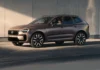
At first glance, the styling brings a more familiar sort of vibe (and, more importantly, identity) to the brand’s compact electric SUV option. You get a more distinctive front end, a profile that more closely resembles its gas-burning counterpart, and an updated cabin with — you guessed it — more screens!
Before we get to that, a couple more items on the ID. Tiguan’s exterior. The faux grille area is more chiseled to the ID.4’s rounded look, with a full-width light bar and black surround giving it more of an assertive look. In profile, the ID. Tiguan gets a relatively clean set of character lines, and unlike most other EVs in current production, VW did not give into the temptation to stick with flush door handles. Around back, you get another full-width lighting setup, black trim surrounds and an illuminated VW logo.

Both outside and inside, the VW ID. Tiguan does have plenty of distinctive cues to the standard models.
Once you do hop inside, you’ll start to see the ID. Tiguan separate itself from the gas model a bit. You get a squared-off, two-spoked steering wheel, for example. That steering wheel is still machine-gunned with buttons, but at least they are physical buttons here, with a logical layout that looks easy and intuitive to use. You know where else VW canned haptic controls? On the center stack, where a bank of switches house your climate controls.
Moving back to the center console, you get a small volume knob (again, at least you have one now), while VW made best use of the space freed up by the console shifter to fit dual Qi2 wireless charging pads.
In front of the driver, there’s a 10-inch digital gauge cluster, though I do like the setup where it looks like the more old-fashioned Mk4 Golf arrangement from the early 2000s. VW isn’t the first automaker to use digital gauge clusters for retro purposes, but still, it’s a nice touch. It goes on, too, because you can also show a host of classic models in the virtual garage, like the aforementioned Mk4 as well as the original Golf Mk1, the Mk2, the original Tiguan and even the Beetle.
There’s a much larger 15-inch center touchscreen, as well as another 12-inch unit available to the passenger. One other important item on the driver’s side door card: VW ditched the ID.4’s window switch arrangement. Instead of getting just two rocker switches for the windows with another button you had to push to roll down the rear windows, they went back to four proper switches here.
What about powertrains?
The 2028 Volkswagen ID. Tiguan will be coming to the US following its European launch next year, and go on sale in a range of other markets as well. Across the global portfolio, we’re looking at three possible powertrain setups. The entry-level option gives the ID. Tiguan a single electric motor at the rear putting out 188 horsepower, and drawing its energy from a 58-kWh battery pack. A more potent RWD version with 282 horsepower is also in the cards, mated up to a 77-kWh battery.
Finally, the top-end version (the one I’m most confident we’ll see) is the dual-motor, all-wheel drive ID. Tiguan with 295 horsepower and that bigger 77-kWh battery. We may get the rear-wheel drive version as well — that is what VW did with the ID.4, after all — but that has not been confirmed just yet.
In fact, all Volkswagen did officially say about the North American market is that the ID. Tiguan is coming. “Volkswagen has not announced North American timing for the vehicle. Following the European ID. Tiguan launch in early 2027, the company will share North American timing, offer structure, pricing, and other market-specific details in due course.”
The European specs are laid out, at least, in which VW says the ID. Tiguan should manage somewhere around 372 miles of range using the WLTP figures. In terms of EPA ratings, that may land closer to around 325 miles, while options like larger wheels on the R-Line model may also impact the range a bit. That said, this car can also tow up to around 4,400 pounds with the larger battery, which is an impressive number (even if your range will absolutely tank trying to actually do that).
Again, we’ll know more about what we’ll see with the 2028 Volkswagen ID. Tiguan sometime next year. If I were a betting man, I’d wager this new SUV will come in somewhere around where the existing ID.4 sits: somewhere in the mid- to upper-$40,000 range to start. That’s a lot when you compare it to your standard Tiguan, since that would effectively put the ID. Tiguan’s starting point where the gas version stops, if that winds up being VW’s pricing strategy.
We’ll just have to wait and see whether we end up surprised by the bottom-line MSRP, though that will depend on which rear-wheel drive version we see at the entry-level end, if we get a non-AWD version at all. More is coming up soon with our coverage on the ID. Tiguan!