| Pros | Cons |
| ✓ Comfortable, spacious interior | ☓ Not quite as much clearance as other Subarus |
| ✓ Compliant ride and solid handling | ☓ Decent (but not great) driving range |
| ✓ Powerful dual-motor setup | ☓ Lacks special EV features (one-pedal driving, charge mapping) |
| ✓ Less expensive than the Toyota bZ Woodland |
Subaru Trailseeker Overview: The most Subaru EV yet
Along with the updated Solterra, Subaru has been expanding its EV portfolio to closely match its gas-powered offerings, including the smaller Uncharted and this Trailseeker. Not only do these later models benefit from a little more experience as the automaker aims for a foothold among electric buyers, but the Trailseeker particularly interested me because of its profile…and its power. Whatever you may think of the new Outback, this car maintains the proportions folks have come to appreciate over the years. It just so happens this 375-horsepower EV is the most powerful Subaru in current production, too, but are those two main points enough that you should give this car your time, attention and money?
In a word: yes. I mean, if you’re looking for the shortest possible answer without all the minutia I’ll get into below, you should give the Trailseeker a look, even if — and perhaps especially — if you’re cross-shopping it with its gas-powered counterparts, be it the Outback or the Forester.
Why? The new Subaru Trailseeker hits on the points a lot of folks want in the brand. It just happens to be electric. From all-wheel drive capability, including software-assisted aides like X-Mode, to the 71.8 cubic feet of max cargo volume, the relatively uncontroversial wagon-like styling (if you can handle the cladding, that is) and even 3,500 pounds of towing capacity, it ticks quite a few boxes for the adventurous types at which Subaru is aiming here.
Mechanically speaking, it’s true the Subaru Trailseeker is functionally identical to the Toyota bZ Woodland. In fact, Subaru builds both cars at its Yajima plant in Gunma prefecture, Japan. This car, much like the Uncharted/C-HR and forthcoming Getaway/Highlander, came about as a joint development with Toyota, so you may consider any comparison a hair-splitting exercise. Even so, I did recently review the Toyota bZ Woodland, so we are going to delve into which of the two I’d consider as the better option.
Getting a closer look at the Trailseeker, inside and out
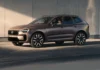
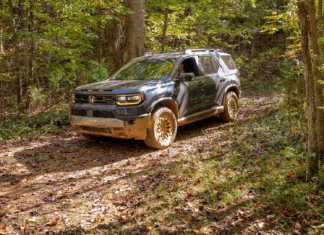
As far as exterior styling goes, the Subaru Trailseeker adopts what I’d consider a more conventional front end. Both the running light and headlight elements are more prominent than the Toyota bZ, as are the faux grille that is only interrupted by a large Subaru logo (and front camera, if you go for the Limited or Touring models that have it). The Subaru’s profile is basically the same as its sibling, though out back you get the brand’s lettering on the tailgate and a slightly different lower bumper design. I’m personally more drawn to the Subaru because I find Toyota’s new corporate styling too car-like, whereas this cuts a more rugged figure, but choosing between the two on looks is largely down to your preference.
One exterior option Subaru offers for the Touring trim is a two-tone paint option with a black roof, which you can get as a no-cost package if you want it.
Overall, the Subaru Trailseeker rides on the same 112.2-inch wheelbase as the Solterra. In this application, though, you get 190.8 inches in total length, or about six additional inches. You’re essentially looking at the same argument with these two Subarus as you are between the bZ and bZ Woodland, so if you want the extra cargo space, you’ll want to take the latter options under either brand.
Inside, the 2026 Subaru Trailseeker Touring we have here comes fully loaded, including the $300 leather upholstery option. You also get a panoramic glass roof with a power sunshade, as well as dual wireless charging pads, a 14.0-inch touchscreen infotainment system and a 7-inch display. Apart from the badge on the steering wheel, the Subaru is again functionally identical to the bZ Woodland. There are a few minor tweaks, though, including a three-stage drive mode button for Eco, Sport and Normal modes (the bZ only gives you ‘Eco’ mode) and a flat top and bottom steering wheel.
It’s another preference point, but the Subaru Trailseeker also offers a contrasting blue and black leather option, if you go for the top-end Touring. Coupled with some metallic accents, I generally found the Subaru’s interior a more pleasant place to be than the bZ Woodland in the week or so we spent driving it around our home base.
If you’re looking for more of a road tripper, one thing to consider with the Trailseeker is its front storage space, or the lack thereof. This EV doesn’t have a glove box, so you’re stuck putting your things in either the center console or the small cubby below the gear selector and charging pads. There is some space, but while the main draw is plenty of storage space in the rear, you don’t have quite as much accommodation to keep things easily accessible up front compared to the dual-level console, wider door pockets and traditional glove box in the Outback.
With rear HVAC vents, dual USB-C charging ports, 35.3 inches of legroom and 38 inches of headroom with the panoramic roof, the Subaru Trailseeker can pretty easily accommodate two full-sized passengers in the back. The flat floor does make it a bit smoother to have a third back there at a pinch, though I wouldn’t necessarily recommend that for longer trips (though you’d also have the same issue with either the bZ or the Solterra).
The Subaru Trailseeker wins on performance — with one asterisk
The storage issue is more of a nit-picky thing, mind you, because the Trailseeker’s general performance is top-notch…mostly. With that 375 horsepower, dual-motor layout, this car can manage a 0-60 sprint in an impressive 4 seconds. It’s plenty quick for its on-paper power figures, to the point that it can break the standard all-season tires loose with ease. Though it pains me to say it, this Trailseeker is about 1.5 seconds quicker in the sprint than even a stock WRX, making this the quickest Subaru in current production.
Still, it isn’t (and is not really meant to be) a sports car. Having a drive unit at each axle to meter out power as part of Subaru’s symmetrical AWD system and balance this electric wagon’s 4,510-pound curb weight makes it fairly neutral and predictable in most conditions, though it will protest if you really try to push it. The Bridgestone Turanza tires don’t help its case on the handling front, though they can take the sort of passing maneuvers where the power actually comes in useful without any drama. Let’s stick with the tires for another moment, actually, because Toyota offers Dunlop Grandtrek all-terrain tires as a no-cost factory option if you want more of an adventure-ready rig. Subaru doesn’t, and I find that to be a weird omission considering this car’s advertised purpose.
There is one good reason why the Subaru Trailseeker strictly comes with all-seasons from the factory, though: range. The automaker advertises this model, which packs a 74.7-kWh lithium-ion battery under its floor, can manage up to 274 miles on a charge (or 281 if you get the base Premium model with smaller wheels). In the main, that’s a perfectly acceptable figure for most daily drivers. It also packs a NACS port so you can charge up on Tesla’s Supercharger network, and you have plug-and-charge capability.
In the right conditions, you can charge up to 150 kW, which means you can generally get from 10-to-80% state-of-charge in around 28 minutes. The Trailseeker also gets intelligent battery preconditioning, something the older Solterra was sorely missing. You do have to use the car’s built-in navigation system and point to a charger so it knows to precondition, however, or you have to engage it manually.
While you’re working your way through that charge, you’ll find the Subaru Trailseeker is pleasantly quiet — one of the benefits of not having all-terrain tires from the jump — with comfortable seats and a smooth ride. The soft and supple ride is easily the best
My largest complaint that applies both to this and the bZ Woodland is the lack of another EV staple: one-pedal driving. You do get selectable regen modes through the paddles, though going from level 1 (coasting) to level 4 is a relatively jerky experience compared to other EVs…and it also resets whenever you power-cycle the car, so you keep having to go back to whichever level you wanted in the first place.
What about X-Mode?
One feature I haven’t explicitly mentioned is X-Mode, which gives you some more software control over the drivetrain for snow, dirt or muddy conditions. Given the tire arrangement, we broadly kept our testing to on-road components — we’ll have a Loveland Trials range test coming up in a couple days — though I can share some experience from the closely related Toyota bZ Woodland.
X-Mode has been Subaru’s thing for more than a decade now, with a dual-function setup available across its gas models for the last several years. That is effectively what you get here, with one setting for snow and dirt, and a more extreme option for deep snow and mud. The system works remarkably well with an EV, as you can make well-controlled use of the low-down torque to navigate low-traction situations. Even better, the Grip Control switch next to X-Mode functions as a sort of low-speed cruise control that, coupled with Hill Descent Control, allows you to focus on steering.
My take from some light off-roading with X-Mode enabled is that it will pull you through some tricky situations, even as the brakes stab away at whichever wheels slip to try and help gather and maintain forward momentum. Your main limiting factor is going to be the 8.5 inches of ground clearance. While that’s about average for most crossovers these days and good for snow, you wouldn’t want to take on any extreme obstacles with that sort of clearance and how long the Trailseeker is, as you’ll run into issues with approach, departure and breakover. For getting to most campsites, though, it’s a plenty capable package, while X-Mode offers some additional peace of mind.
Verdict: The Trailseeker is an EV that remains faithful to Subaru’s successful wagon formula.
If we’re strictly comparing the Subaru Trailseeker to the Toyota bZ Woodland, I’d lean more toward the Subaru after some time with both. Not only do I think the Trailseeker is the better-looking option, but it’s also priced more attractively to its Toyota counterpart. It offers a lower base option in the $41,445 Premium (including destination). The bZ Woodland starts at $46,750, by contrast.
Above the entry-level model, even the mid-range Subaru Trailseeker Limited — the trim equivalent to Toyota’s base bZ Woodland — is still less expensive ($45,445 versus $46,750). At the top end, as well, this fully-loaded Touring with leather comes in at $48,305 (against $48,995 for the Toyota). While our Touring came in Magnetite Gray, you can choose either Sapphire Blue Pearl or the $395 Daybreak Blue Pearl option if you really want to double down on matching the interior and exterior vibes.
The new Subaru Trailseeker comes at a time when the Outback has moved away from its wagon roots toward a more upright SUV. If you’re not a particular fan of the new Outback’s styling (to each their own), this does strike me as a spiritual successor to the past Outbacks…if you can buy into the EV lifestyle. That may be a bridge too far for some, but if you are open to considering an EV, I recommend giving the Trailseeker a look. Much like my experience with this, and the bZ Woodland for that matter, you might just like it more than you think going in.
Check out more on the Trailseeker below, including our Loveland Trials (coming soon!):