It’s a tough time for new car sales from many different angles, but there may be an interesting trend emerging in the data.
As gas prices continue to spike and new car prices continue their depressingly upward trend, there’s not a ton of good news in the sales data. Take Mazda, which still reports monthly and just released their numbers for April 2026. The general upshot is what you’d expect given my lead-in: Sales volume is down 15% from this time last year. This past April, dealers moved 125,601 vehicles, while they sold 147,976 throughout April 2025. Particularly if you pore over the numbers as they’re published, you expect to see some slump. That said, a couple models pulled out better results than others.
Take the Mazda 3, for example.
While I have a special affinity for that car (I owned one and it’s one of the few “affordable” cars left you can get with a manual transmission…and it’s a good manual transmission, at that), it’s been sliding into insignificance in terms of sales volumes over the past few years. This time around, the hatchback picked up by 34%, selling 1,149 units this past month and 5,591 for the year thus far (year-to-date, Mazda 3 hatch sales are up almost 60%). Granted, the sedan didn’t fare quite so well (down 12% for the month, at 2,086 units), but the hatch’s surprising popularity this year means the model is at least holding its own.

Then there’s the Miata.
This past month, sales for the MX-5 Miata lineup as a whole, including the softtop and the hardtop RF, leapt by 60%. Overall, the total volume stands at 1,163 units for the month of April and 2,858 units for the year. That’s not a ton of cars in the grand scheme of things, but that result outpaces the Toyota GR 86 and Subaru BRZ — and by a hefty margin, too. So while sales for the full year are (sadly) down about 10% even with April’s strong figures, things are looking pretty good as we make our way through spring.
Of course, it also makes sense that the Miata is doing well right now, since we’re coming up on prime convertible season.


Two of Mazda’s SUVs are doing well. The other ones…not so much.
Even for a medium-sized automaker like Mazda, the lion’s share of its fortunes (good are bad) still rest with its SUV lineup. By overall volume, the CX-5 is still the king, with buyers in the U.S. taking home 10,206 examples in April (down 19%), and 45,198 (down 4%) so far this year. Now, there’s a new CX-5 on the block, and the switchover is likely a big factor in why sales are down at the moment. As the company ramps up the new model and introduces the CX-5 Hybrid, we may see some momentum. That said, the fact that Mazda builds all CX-5s in Japan may hurt its overall performance, depending on the ever-evolving tariff situation.
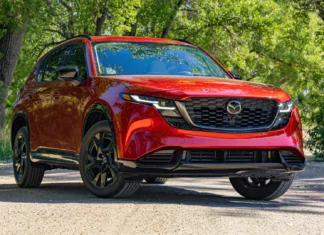
That’s where the American-built CX-50 comes into the picture. Not only were the 50’s monthly sales up 6% in April 2026 versus this time last year, but it’s year-to-date sales are up about 20%. So, while the CX-5 may be down at the moment, it’s possible buyers aren’t leaving the Mazda brand for something else — they’re just going over to the CX-50 (which is readily available and has a hybrid version) instead.

The smaller CX-30, by contrast, isn’t doing nearly as well.
Monthly sales for April are down 35% (4,067 sales), and the picture for all of 2026 so far is even worse (down 56%). Now, according to the automaker there is a good reason for this: Mazda builds the CX-30 in Mexico, and reportedly scaled back production to deliberately lower inventory. There’s not necessarily a lack of demand by that metric, then, but a shift toward higher-margin vehicles like the CX-50, which doesn’t face tariffs, instead. To that end, the fact that there’s not much of a price delta between the two models — the CX-50 starts only about $2,525 higher than the much smaller 30 — Mazda is supposedly trying to nudge people into the larger and potentially more profitable option.
On the other side of the lineup, you have the CX-70 and CX-90. Both are down around 40%, and the reason for the drop could be two-fold. Again, Mazda is a heavily import-dependent automaker. It builds the CX-70/90 at its Hofu plant in Japan, where import levies make these relatively expensive models even pricier to end buyers. So, if you’re looking for a five-passenger SUV, you may be gravitating toward the CX-50 instead. That seems to hold true with the (slow) CX-70 sales figures, as dealers sold just 970 units in April. If you need a three-row, the CX-90 is your only option in Mazda’s lineup. Volume-wise, the 3,286 units looks a little better, but that’s also 39% down from the same time period a year ago.
People seem to be leaning toward more affordable models as prices creep toward untenable
It’s absolutely no secret right now is one of the most financially painful times to buy a brand-new car. Average transaction prices stubbornly remain above $50,000. That leads consumers to either buy used (which is squeezing used prices higher as the ratio of used-to-new buyers increases), or pick a more affordable option if they do buy new.
To that end, Mazda seems to be putting its eggs in the CX-50’s basket, as well as leaning on value with the Japan-built CX-5 to try and keep its cash cow going. And unlike large automakers (Toyota, Honda, etc.) that can try to offset pain points through sheer volume, mid-sized manufacturers like Mazda (and Subaru, for that matter), don’t have quite as many options to try and make their margins.
On a larger scale, we’ll get a better picture into how sales are looking as the second quarter wraps up. We’ll get those results from companies that report quarterly in early July.